As a Grave Care Business owner, you must have the humility to learn other cultures’ burial practices that might be unfamiliar. Our goal is to give you the framework to operate a successful Grave Care Business.
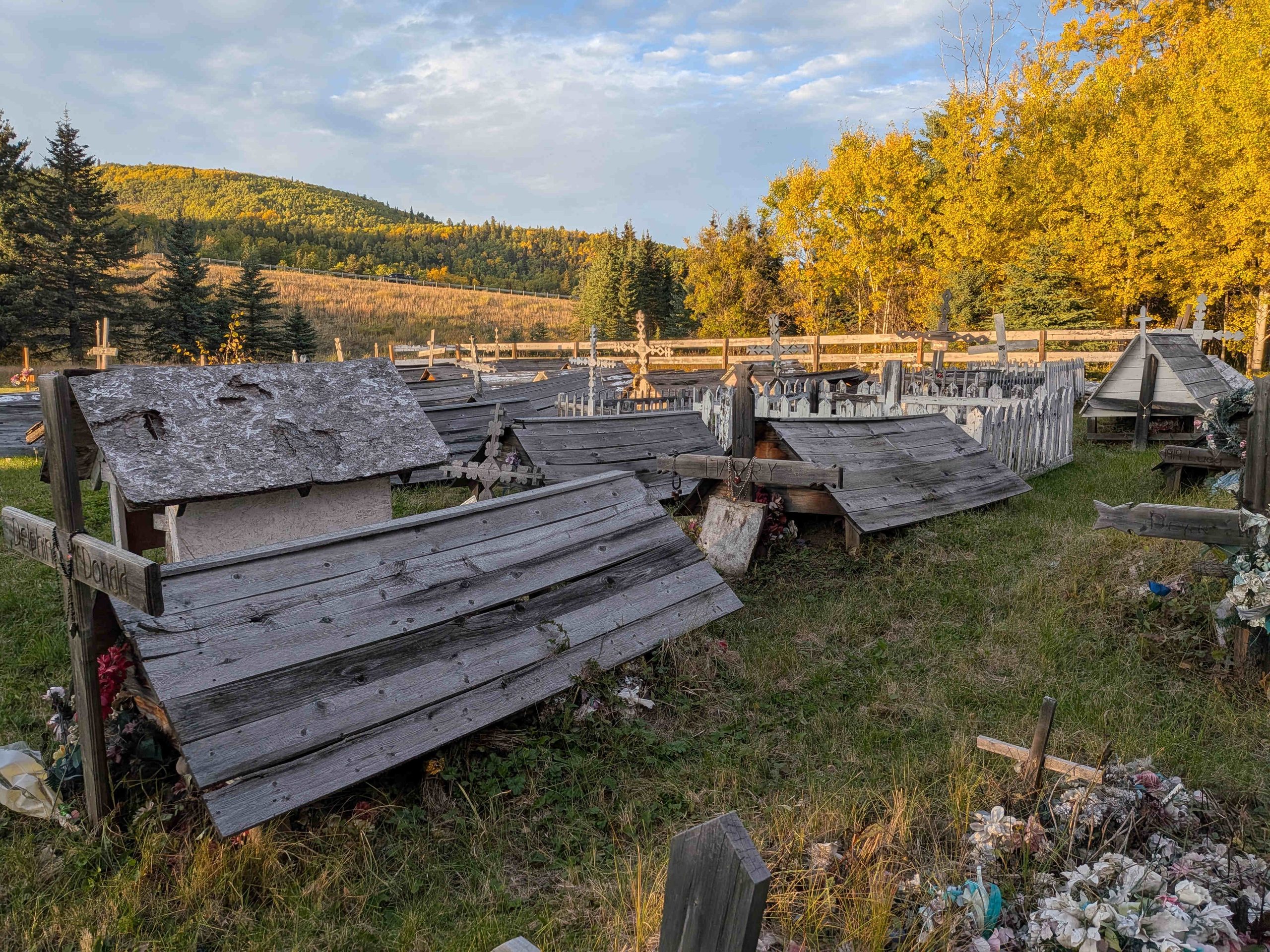
I am continuously learning about cemeteries and burial practices across many cultures. Today, let’s look at a burial style I found during my visit to northwest Canada. These grave styles are called “Spirit Houses.”
There are places where the dead are buried.
And then there are places where the dead are given a house.
In the province of Alberta Canada, I found one of those places.
This cemetery is home to dozens of small structures known as Spirit Houses—a distinctive form of vernacular burial architecture found throughout northwestern Canada.
At first glance, they look like tiny houses standing over the graves.
And, in a sense, that is exactly what they are.
They are not simply decorations placed beside a grave. They are part of a tradition of memorializing the dead through structures that resemble the homes, shelters, and familiar places of the living.
Each one tells us something.
Not only about the person buried beneath it, but about the people who built it and about the way a particular community understands death, remembrance, and the relationship between the living and the dead.
That is one of the things I find fascinating about cemeteries.
A cemetery is never just a collection of graves.
It is a record of human ideas.
Walk through an old cemetery and you can see those ideas expressed in stone, wood, iron, flowers, symbols, monuments, mausoleums, burial chambers, and even the arrangement of the graves themselves.
Different cultures have answered the same fundamental question in remarkably different ways:
What should we do with the memory of someone who has died?
Some people build enormous monuments.
Some mark a grave with nothing more than a simple stone.
Some decorate graves with flowers.
Some return to the cemetery on particular days of the year.
And here, people built little houses.
There is something profoundly moving about that.
When someone we love dies, the relationship does not simply vanish. The person is gone, but our need to remember them remains.
Perhaps that is why the forms of burial and memorialization found around the world are so endlessly varied.
A grave is a physical object, but the meaning we give that grave is cultural.
It can tell us what a community believes about family.
About ancestry.
About home.
About death.
And sometimes, simply about love.
Standing among the Spirit Houses of, I began thinking about the strange and beautiful things human beings build for their dead.
A tiny house over a grave may seem unusual to someone who has never encountered the tradition.
But once you understand the idea behind it, it becomes remarkably familiar.
We build houses for the people we love while they are alive.
We give them shelter.
We make a place for them.
And when they are gone, perhaps we are not quite ready to stop building.
So we build one more house.
A little house.
A house that cannot be lived in, but can be remembered.
And perhaps that is one of the great lessons cemeteries can teach us:
There is no single human way to remember the dead.
There are thousands.
And every one of them has a story.
My goal is to understand burial practices from around the world. My goal is also to understand how we can maintain cemeteries and gravesites while we also respect cultural practices.
Have you ever thought about starting your own Grave Care Business?
Visit our main website to learn more:
GraveCareBusiness.com